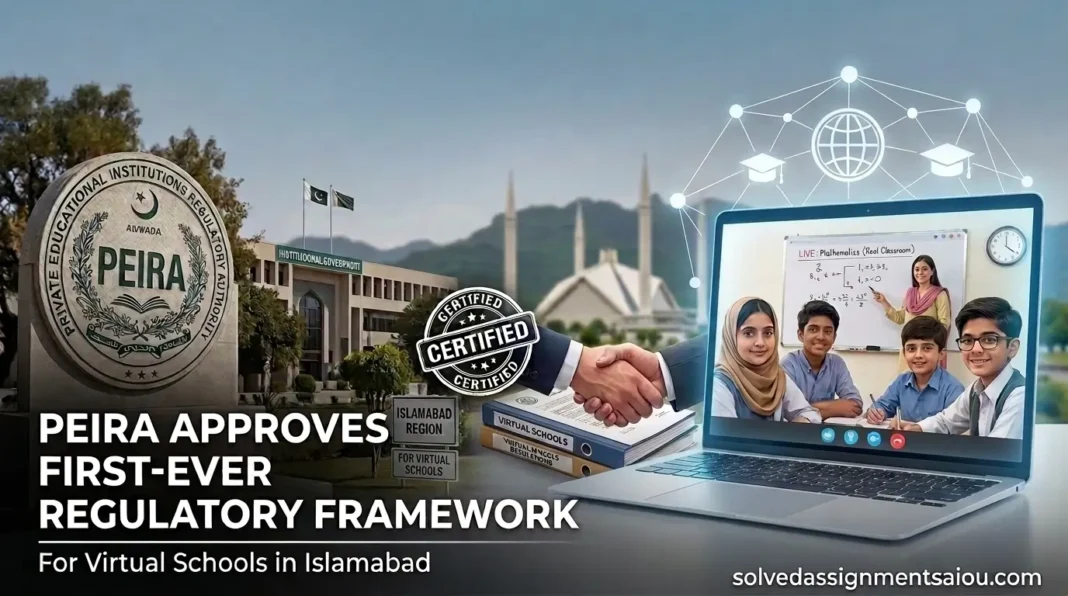
Online learning is no longer a backup option in Pakistan — it is becoming a formally recognised part of the education system in curruent situation. The PEIRA online school registration Islamabad has approved after a long time the country’s first PEIRA virtual schools regulatory framework for virtual schools operating in the Islamabad Capital Territory (ICT). This move brings structure, accountability, and quality standards to a sector that, until now, largely operated without clear rules.
For parents, students, and school owners exploring online education, this is a significant development. Here is what the new PEIRA virtual schools regulatory framework actually covers, and why it matters present the PEIRA virtual schools regulatory framework.
What Is the New PEIRA virtual schools regulatory framework?
Vrtual school rules Pakistan 2026 the framework establishes a formal system for the registration process, regulation, monitoring, and quality assurance of online and virtual schools up to the higher secondary level. In simple terms, any virtual school wanting to legally operate in Islamabad will now need to meet defined standards, register with PEIRA ICT-PEIRA digital education policy and remain under continuous oversight.
According to PEIRA the policy is designed to expand access to quality education for groups who often struggle to attend traditional schools, including:
- Out-of-school children
- Students living in remote or underserved areas
- Children with disabilities
- Working learners who cannot attend regular, in-person classes
Key Rules Under the New Framework
Teacher Training and Learning Management Systems
Virtual schools will be required to provide mandatory teacher training in digital teaching methods. Instruction must also be delivered through secure learning management systems (LMS), ensuring lessons, assessments, and student records are handled through verified, standardised digital platforms rather than informal tools.
How to register a virtual school in Islamabad?
Given that virtual schools operate entirely online, the framework introduces defined cybersecurity standards to protect student data and platform integrity. PEIRA will also maintain read-only access to school systems for oversight and compliance checks, allowing the authority to monitor academic activity without interfering in daily school operations.
Grade-Wise Standards and Screen-Time Limits
Rather than applying one blanket rule to every age group, the framework sets separate standards for primary, middle, secondary, and higher secondary virtual education. These include specific requirements for teacher qualifications, screen-time limits, arrangements for practical or lab-based learning, curriculum alignment, assessment rules, and student wellbeing safeguards.
Why This Matters for Pakistan’s Education System
PEIRA Chairman Dr Ghulam Ali Mallah described that online school teacher training requirements PEIRA the move as an important step toward modernising Pakistan’s education system through responsible digital innovation, adding that the framework could serve as a model for other provinces and regions.
This matters because online education in Pakistan has grown quickly in recent years, but largely without a consistent regulatory checkpoint. A formal framework means parents can verify whether a virtual school is properly registered, teachers must meet minimum training standards, and students benefit from monitored, virtual school screen time limits Pakistan instruction rather than informal or unverified programmes.
What Should Parents and Schools Do Next?
learning management system like AIOU LMS Portal is more effective in this mission. If you are considering enrolling a child in a virtual school digital learning or if you run one, it is worth reviewing PEIRA’s registration requirements early. Schools that align with the new standards now — from teacher training e-learning standards records to LMS security — will be better positioned once enforcement and compliance checks begin in earnest.
Families evaluating online schooling options should ask directly whether an institution is registered under the ICT-PEIRA framework, since this registration is now the clearest signal of a legitimate, quality-assured virtual school.
Final Thoughts
PEIRA virtual schools regulatory framework marks a turning point for online education in Pakistan. By formally recognising virtual schools while holding them to defined academic, safety, and technical standards, the policy aims to make digital learning more trustworthy for the families who rely on it most. You can also visit to know about this regulation framework to visit PEIRA Official Website.