Are you enrolled in the Allama Iqbal Open University (AIOU) BS Environmental Studies programme and looking for reliable, updated, Basic and LMS-ready solved assignments? You’ve landed at the right place. At SolvedAssignmentsAIOU.com, we offer free, high-quality AIOU BS Environmental Studies solved assignments in PDF format fully aligned with the latest university syllabus and LMS portal guidelines.
Subject Name
No.1
No.2
9378-Ideology and constitution of Pakistan Solved assignments Autumn 2025
بی ایس پروگرامز کے کورسز کی تعداد بہت زیادہ ہونے کی وجہ سے تمام مشقیں اپ لوڈ کرنا مشکل ہے اکیڈمی کی طرف سے ہر ممکن کوشش کی جاتی ہے کہ زیادہ سے زیادہ کوڈز اپ لوڈ کیے جائے پہلے سمسٹرز کے طلبہ کی حوصلہ افزائی کے لیے امتحانی مشقیں اپ لوڈ کی جاتی ہے باقی سمسٹر کے طلبہ امتحانی مشقوں کے لیے اکیڈمی کے نمبرز پر رابطہ کر سکتے ہیں
At SolvedAssignmentsAIOU.com, we understand how critical timely, well-structured, and LMS-compatible assignments are for your academic success. Here’s what makes our platform stand out:
Sample Free: Download AIOU BS Environmental Studies assignments at no cost — no registration required.
Unique Content: Our team regularly updates each assignment based on the Spring 2025 syllabus and AIOU’s current guidelines.
Available PDF Files: Lightweight, mobile-friendly PDFs — ideal for reading and downloading on any device.
Multiple Subject Coverage: From Environmental Ecology to Climate Change and Sustainable Development, our collection spans every major BS Environmental Studies subject offered by AIOU.
Explore now: Solved AIOU Assignments for Spring & Autumn
How to Download Your AIOU BS Environmental Studies Assignment PDF
Understanding the University of Karachi Admission Test Results
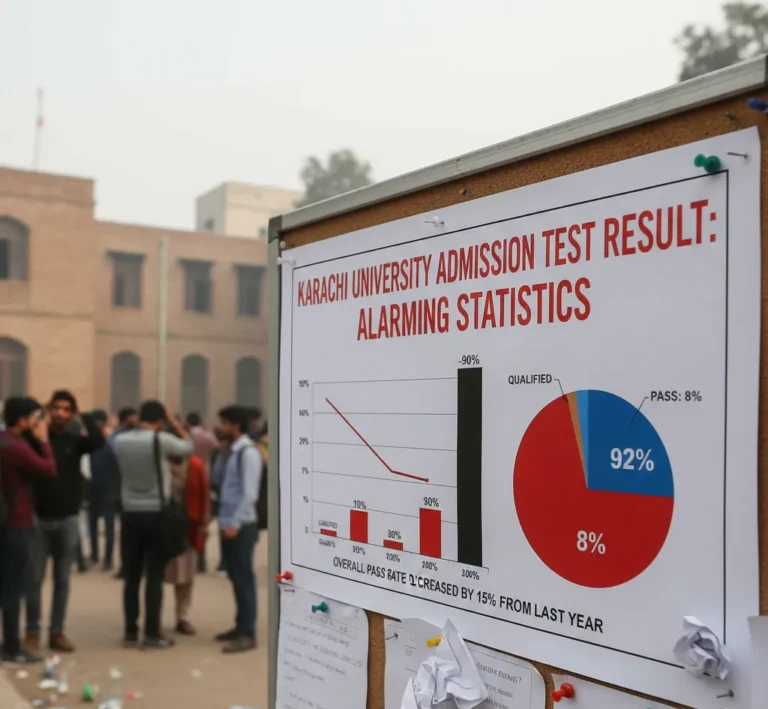
The latest results of the University of Karachi admission test enables a deeper understanding of student performance and the intense competition for access to higher education. The University data shows that the most successful students in the cohort were those students who achieved marks between fifty and sixty as witnessed by one thousand seven hundred and thirty-five students. Of the total student pass rate, this was the highest number of successful students versus the starter hurdle of high marks. An additional near twenty percent of candidates achieved between sixty and seventy marks, which illustrate the steady decline as students successfully score between fifty and sixty marks onward.
To some degree there are not very many candidates achieving outstanding scores. Only two hundred and sixty-three student achieved a score of seventy or above, and even less, only twenty students, scored between eighty and ninety as category. Very few achieved those marks and not a student scored above ninety, or zero-point two-eight percent of the total student cohort has scores of eighty or above. The admission test comprised twenty disciplines of study with the very high-demand options, such as Pharmacy, Computer Science and others same like PU Admission test, including Artificial Intelligence, Business Studies, and other disciplines of study. This article of data suggest that the majority of students are capable of achieving the minimum or higher – yet few are capable of achieving excellence, therefore endorsing a demanding study plan and commitment for prospective candidates.
Implications for Students and Academic Preparation
The results of the admission test at the University of Karachi highlight current educational levels and the need for purposeful preparation. To students this means that simply clearing the passing marks may not ensure a seat in the more competitive programs like Artificial Intelligence, Computer Science or Pharmacy. Greater score achievements will not only create opportunities for admission in competitive disciplines, but also career pathways within these areas that advocate technical prowess and innovation.
To parents, it is important to understand these stats to help align study habits and plans for students. Providing students with supportive resources, mock tests and preparation personnel will help students and can substantively contribute toward results. Teachers and institutions provide the most contributing factor of assisting students with understanding gaps and building solid conceptual foundations facilitating with the academic rigor synonymous with universities. All of these combine efforts from students, parents, and teachers can work toward providing a more competitive academic environment and status level of results for subsequent admission tests.
The Launch of the Digital Forensic Science and Technology Centre
In a significant boost to both higher education and research, the University of Karachi has unveiled the Centre of Digital Forensic Science and Technology, the first university-based digital forensic centre in Sindh. This cutting-edge centre, which includes modern classrooms, research laboratories, and administrative offices positioned to stimulate scholarly excellence and unbridled creativity in the digital security domain, was built with federal support, through the Higher Education Commission, at a cost of Rs 308 million and consists of 38,000ft2.
The centre is designed to advance research, develop specialized training, and cultivate skill sets in digital forensics, cyber security, and data analysis. Academic operations will begin in the coming months, providing students with avenues for entering an emerging career path. Consequently, this project represents considerable progress toward developing future digital forensic professionals and enhancing Pakistan’s academic and technological capacity. Furthermore, for students focused on Computer Science or Artificial Intelligence, this development offers a look into the future of education in which technology, research, and scholarly integrity correlate protectively and lockstep.
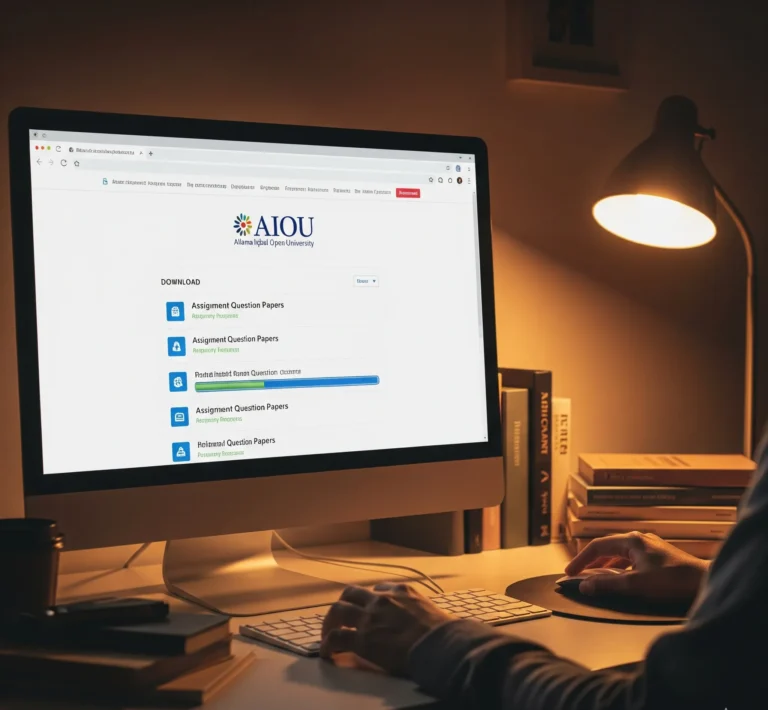
If you are a student of Allama Iqbal Open University (AIOU) and want to know how to download AIOU assignment question papers, this complete guide is for you. Once your admission is confirmed, AIOU provides an official link via SMS and on its website for students to download the correct semester’s assignment question papers. This article explains step-by-step how to get your AIOU question papers, avoid downloading old ones, and understand the difference between regular and LMS assignments.
AIOU assignment question papers download
How to Download AIOU Assignment Question Papers After Admission
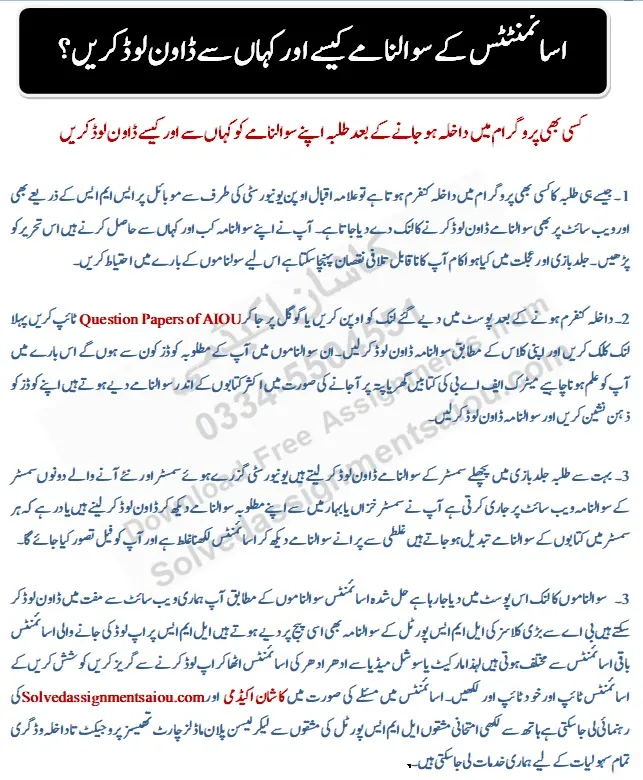
As soon as your admission is confirmed in any programme, the university will provide you the download link via SMS and on its website. You must know when and where to obtain your question-paper.
Step-by-Step Guide to Access Your AIOU Papers Online
After your admission is confirmed, open the link provided (or go to Google and type Question Papers of AIOU click the first link, and download the question paper according to your class. Inside your books at home you’ll often find the question papers with codes — so memorize your correct codes and then download your question-paper.
Important Tips to Avoid Old or Wrong Semester Question Papers
Many students in haste download the previous semester’s question-paper by mistake. The university publishes both the previous and new semesters’ question-papers on its website. You must download the question-paper for your specific semester (Autumn or Spring) because books and question-paper codes change each semester. Writing assignments using old question-papers is wrong and you may be failed.
Understanding LMS Assignments and Solved Paper Guidelines
The link for the question-papers is provided in this post. Solved assignments according to those question-papers are available for free download on our website. For BA and higher programmes the LMS portal question-papers are provided on the same page. The assignments on the LMS portal differ from the usual assignments—so avoid picking random assignments from the market or social media. Try to type the assignments yourself. For help with assignments in case of difficulty you may consult Kashan Academy and SolvedAssignmentsAIOU.com — from handwritten exam drills, LMS portal exercises, lesson plans, models, charts, thesis/project work up to admission and degree level, you can avail all facilities through our services.
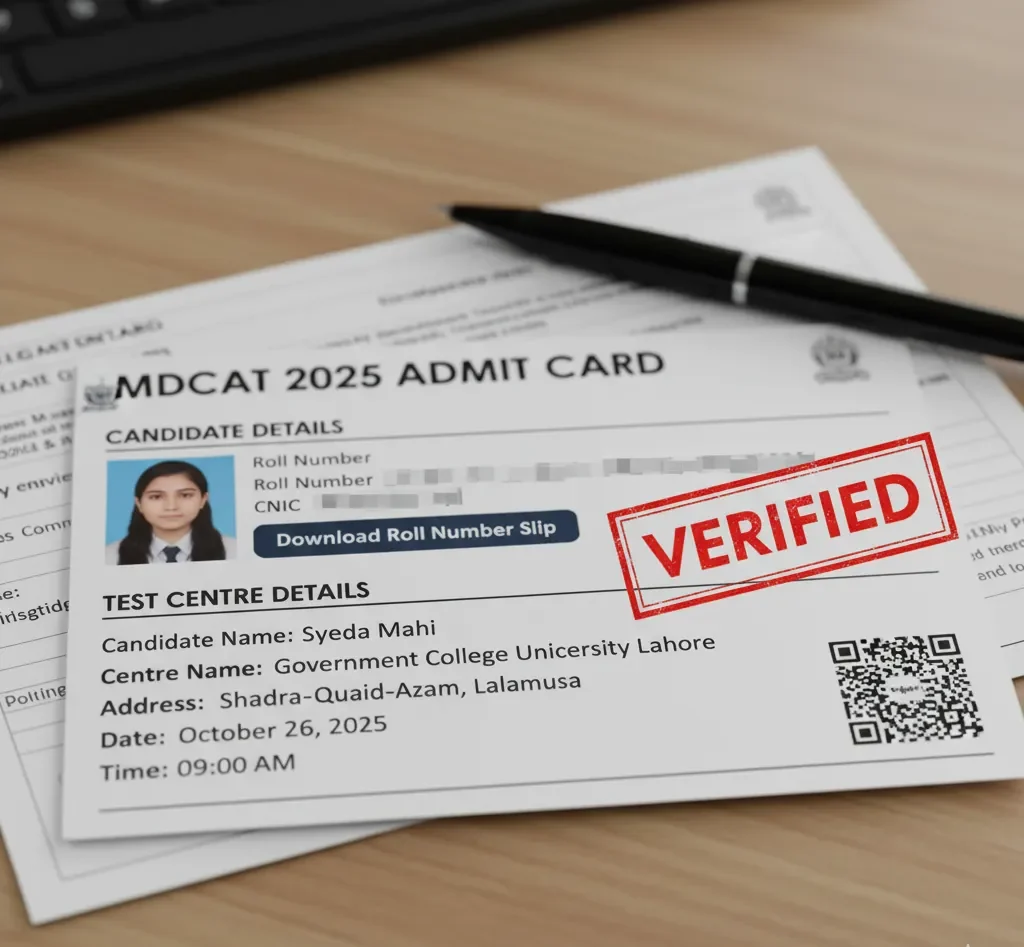
What the “MDCAT 2025 roll number slip” is and why it matters
The MDCAT 2025 roll number slip is the official admit-card issued by your provincial testing body ahead of the Medical and Dental College Admission Test (MDCAT) scheduled on 26 October 2025. On this slip you will see key details – your personal roll number, the name and address of your test centre, your reporting time and seat number. Without a printed copy of this slip and the original CNIC / B-Form, you will not be allowed to enter the examination hall. For many students the slip is more than just a piece of paper – it is your official ticket to enter the exam room. That means you want to download it early, print it carefully, check all the details and keep it safe.Alt-text image above: “Printed MDCAT admit card showing test centre details.
How to download and print your MDCAT 2025 roll number slip
Getting your slip is straightforward if you follow the right steps. Here’s how:
Visit the website of your provincial testing authority (for Punjab, the University of Health Sciences Lahore (UHS); for KPK perhaps Khyber Medical University (KMU); other provinces likewise).
Click on “MDCAT 2025 Roll No Slip” or “Admit Card” link you see.
On the next screen, enter your registration number, CNIC, B-Form or username, and click Download.
You also save the PDF file to your computer or phone and print the roll number slip on plain A4 white paper. It’s a good idea to print at least two just in case you misplace one.
After you print it, check all the details. This includes your name, roll number, address of your test centre, seat number and reporting time. You should fix any mistakes before exam day by contacting the testing authority.
Advice for students:
Print one copy for your review during the week before the exam. Keep a second copy in a sealed envelope in a safe place so you will have backup.
There is no need to laminate it – just keep it clean and wrinkle free.
It is a good idea to keep a digital back-up (PDF on your phone) just in case; the printed version is required.
Students printing their MDCAT 2025 roll number slips ahead of the exam.
Exam day instructions and what to bring (or leave behind)
On the day of MDCAT 2025, arriving prepared will help reduce stress and keep you focused. The exam is scheduled for Sunday, 26 October 2025 nationwide. Here’s what you must bring:
The printed MDCAT 2025 roll number slip.
Your original CNIC (if adult) or B-Form (if minor). Without either, entry will be refused.
Two blue or black ball-point pens (no gel pens, no pencils unless permitted).
Here’s what to leave behind:
Mobile phones, smart watches, calculators, bags, notes, or any electronic device. These are strictly prohibited.
Any form of cheat-sheet, reference book or unauthorised item. Misconduct can lead to immediate cancellation of your paper.
Additional guidance:
Arrive at the test centre at least one hour before your reporting time to settle in and avoid last-minute rush.
Find and follow your seating plan (which will be noted on your roll slip) and follow the instructions of invigilators.
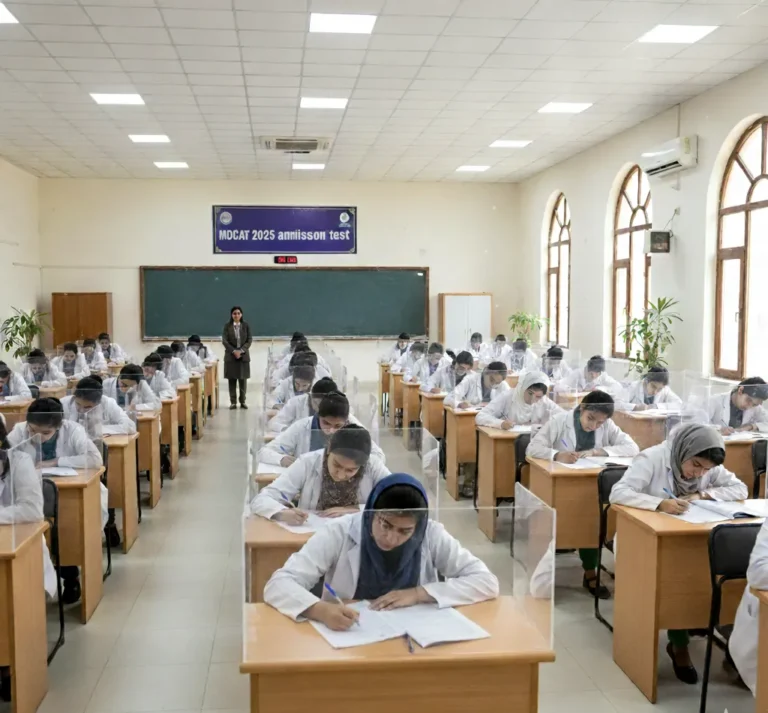
Stay calm and focused. Your slip is your official pass — treat it respectfully and keep it clean. Image alt-text: “Candidates entering MDCAT exam hall October 26 Pakistan.
Final thoughts
Downloading your MDCAT 2025 Roll Number Slip is an easy and important step in your exam. The second you receive your Roll Number Slip, you should print it, verify it, and keep it safe. On exam day (26 October), it may be one of the most important documents you carry with you. By completing the steps above, along with taking note of the exam day information will have you ready to take the test with confidence and clarity, not confusion. Good luck to you, and may your preparation pay off and your examine day be a success!
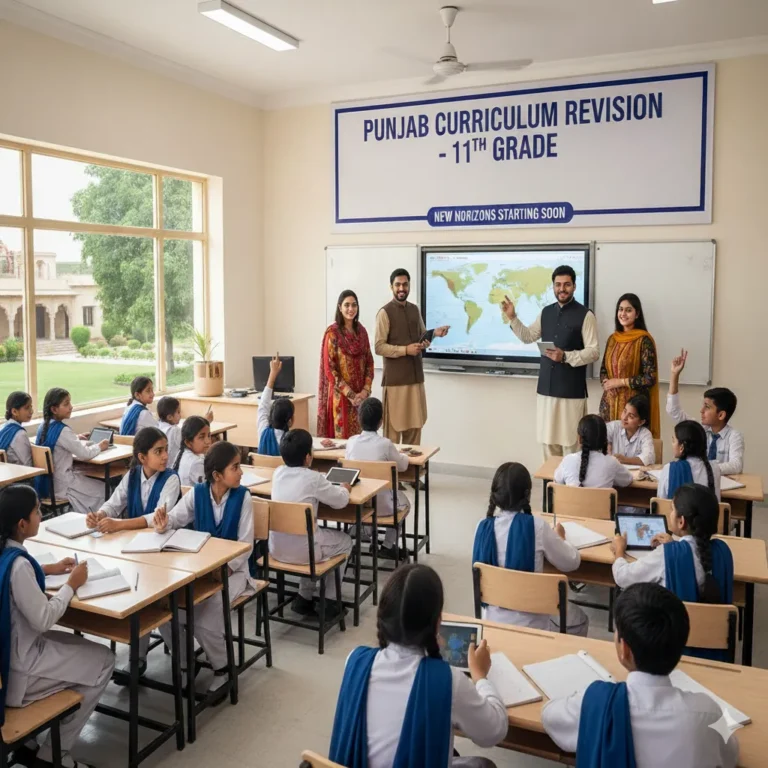
The education framework in Punjab is proactively looking to improve learning for students and satisfaction for teachers. The review of the grade 11 curriculum review Punjab is underway following teachers students complaints syllabus Punjab that raised serious issues with the 11th grade syllabus Punjab. The review follows the updated 9th grade syllabus reduction Punjab from earlier this year that was initiated due to some of the same complaints from the students and teachers. This move is part of the broader Punjab curriculum revision and reflects ongoing Punjab education reforms syllabus efforts.
Reasons the review of the grade 11 is essential:
The new syllabus for grade 11 was released along with the grade 9 syllabus at the beginning of the current session, yet soon developed negative backlash, mostly due to an excessive syllabus class 11 Punjab and mistakes. Teachers and students noted that the syllabus contained too much material that made accurate teaching and learning challenging. In reaction to the overloaded and erroneous 11th grade syllabus Punjab, the Punjab Curriculum and Textbook Board (PCTB) created select committees to undertake a precise reduction in content under the syllabus committee PCTB Punjab framework you can check at HoustonMarketing.
Because of the past and close revision of the grade 9 curriculum, school officials left the meeting with a general and urgent notion that we should review the grade 11 curriculum using the same framework and reduce the amount of content. This action indicates a move towards a less manageable and less meaningful education and contributes to the ongoing curriculum revision Pakistan education agenda.
What the 11th-Grade Review Process Will Involve
The process being followed for the 11th-grade curriculum review Punjab is structured and transparent:
PCTB has already formed dedicated committees to analyse and refine the syllabus for class 11 as part of the PCTB syllabus update initiative.
These committees will work on reducing content, removing errors and ensuring the syllabus aligns with teaching realities and students’ capacities.
For class 9, preliminary recommendations have been drafted and an official notification is expected in the first week of November, setting a precedent for how the class 11 process will unfold.
The review aims not only to shorten and correct the syllabus, but also to improve clarity, relevance and practical teaching outcomes.
What This Means for Students, Teachers and the Education System
The new review will mean that students can expect a curriculum that is easier to navigate, more engaging, and with an emphasis on big ideas rather than volume of content. Teachers will have curriculum that is more linear, with fewer errors to sort through, and more aligned with teaching and learning time. At the system level as for example HEC offer single national curriculumn this move indicates to educators that the educational system is listening and doing something – it establishes a stronger precedent for curriculum responsiveness. The high-school review in Punjab is an exemplar of an educational reform method, that is aligned with global best practices of reducing volume of curricular content, increasing readability and enhancing student-learning experience.
In a practical sense, schools will need to prepare for some changes, such as new textbooks, lesson plans, and potentially some teacher training, once the official announcement comes. Parents and other stakeholders should also be aware, as the schedule indicates that the November announcement will trigger a tangible start of implementation.
Conclusion
To conclude, the decision of PCTB to conduct an extensive, student-level review of the 11th-grade curriculum review Punjab demonstrates a responsive education system in Pakistan. The 11th-grade syllabus Punjab is intended to take out extraneous content, to correct mistakes, and to enhance an already positive teaching-learning experience for all parties. Moving into the November moment, schools and students should prepare themselves for positive improvement.
This revision will be about more than cutting a few pages, rather it will be about meaningful advancement in the experience and delivery of education for all through a structured Punjab curriculum revision process.
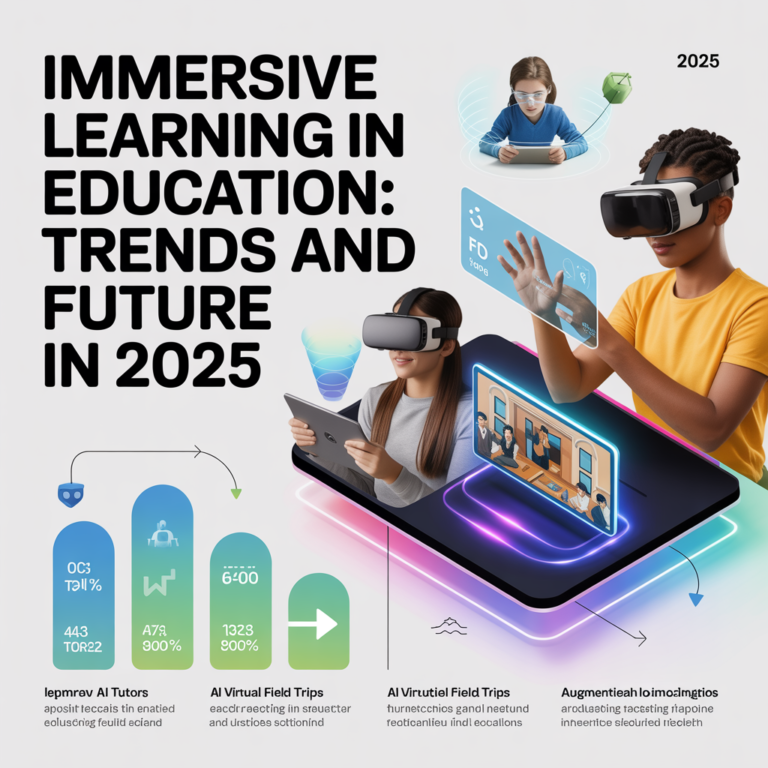
As we Know Immersive education is changing the way schools, colleges and universities instruct and students learn. With immersive tools such as virtual reality (VR), augmented reality (AR) and 360-degree videos becoming commonplace, educators must have a strong set of tools to engage learners in a deeper experience. The projected growth of the metaverse education market—a 43.76% CAGR between 2023 and 2030, equating to nearly USD 24.7 billion market by 2030—speaks to the degree in which the industry is taking the concept of immersive learning in education seriously.
In this article, we will present the rationale for educational institutions to begin implementing to immersive education, following recommendations for hybrid learning models in education to immerse learners.
1. The Evolution of Hybrid Learning and Immersive Learning in Education
Hybrid learning combines traditional face-to-face teaching and online learning, merging the benefits of being in the classroom with the flexibility of studying digitally. This approach primarily reflects previous constraints: traditional classroom environments often meant some students fell behind, and learning fully online did not have the social and interactive richness of the classroom for the time set.
Year after year, hybrid learning has called for innovation — from early e-learning and platforms such as Moodle and Blackboard to the mass adoption of tools such as Zoom, Microsoft Teams, and Google Classroom, more like which has been accelerated by the COVID-19 pandemic. STEM faculties have also been increasing the adoption of immersive technologies, such as PhET Interactive Simulations.
Now we see immersive learning in education — immersively integrating VR, AR, and interactive simulations — is now on the forefront of hybrid learning models. Hybrid models can be defined as immersive + blended learning, instead of just online + classroom approaches.
2. Why Schools Should Embrace Immersive Learning in Education
a) Personalised Learning with AI & Immersive Tech
Immersive learning in education allows for highly personalised experiences. AI-powered systems can monitor when a student struggles and dynamically adjust the learning path accordingly. Robots and codable devices can support hands-on tasks and problem-solving. This tailored approach meets learners where they are, whether advanced, visual, kinesthetic or needing extra support.
b) Enhanced Engagement via Gamification & Immersion
To full Case study Integrating gamification and immersive learning in education promotes motivation, engagement and retention. Students can engage in virtual laboratories, use AR “cubes” to manipulate 3D artifacts, or engage in VR role-play activities. These experiences enhance student engagement when compared to traditional lecture formats. Research demonstrates that immersive learning environments relate to improvements in attention, memory and problem solving abilities. ijrehc.com+1
c) Theory to Practice in Real-World Contexts
One of the most compelling benefits of immersive learning within education is that it can mimic real-life experience. This is true in medical, engineering, architecture and history: students will dissect virtual frogs, walk through an interactive 3D structure, or take a trip to a virtual field-trip. For hybrid education models, online and in-person sessions can blend immersive modules together, bringing the full design experience of the real world into any classroom although it is a disconnected experience.
d) Cost-Effectiveness and Scalable
as Tech you can read Tech Sites like Techcrunch.com While the start-up cost of hardware and software may appear steep at first, immersive learning in education will pay dividends over time. Reusable virtual reality modules, scalable augmented reality lessons and blended delivery de-emphasize the need for physical infrastructure, printed materials and fixed laboratory inventory. Institutions are recognizing these practices more and more within their annual
3. Implementing Immersive Learning in Education: Key Considerations
Select a suitable technology for your pedagogical objectives.
Consider whether the aim calls for deep immersion (VR) or contextual overlay (AR). For examples:
Choose VR for deep immersion (e.g., virtual surgery, exploring an ecosystem).
Choose AR for augmenting a physical classroom (e.g., visualising an engineering part).
Design for accessibility and diverse learners for new.
So for Immersive learning in education must address various learning styles (visual, kinesthetic, audio) while accommodating special-needs students. Make this design inclusive, include fallback options and ensure that the technology supports adaptive learning pathways.
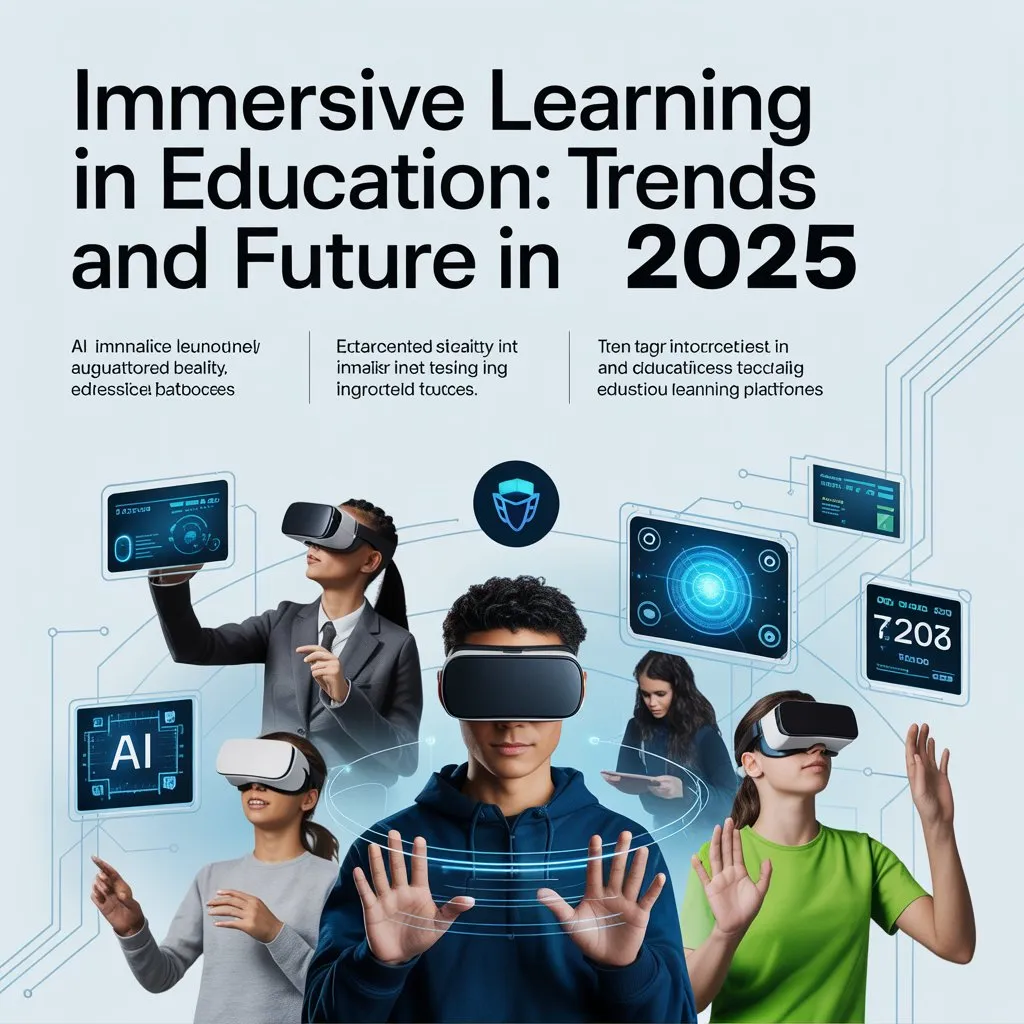
“Immersive learning in education uses AR and VR to enhance hybrid classroom experiences.
Train teachers and embed pedagogically.
Successful immersive learning in education rests on the readiness of teachers. This requires you to invest in professional development and new Educational trends designing an immersive curriculum and your technology aligns with the learning outcomes. Start small, pilot some modules, evaluate them and scale.
Measure and refine, using data & feedback, not just anecdotally.
Leverage analytics and feedback loops to monitor how immersive learning in education affects learner retention, performance and engagement. Research has indicated improved outcomes but it has also indicated usability problems and problematic implementation issues..
4. The Future of Immersive Learning in Education Beyond 2025
Toward fully immersive metaverse schools
Imagine virtual campuses where students meet in 3D environments, collaborate, experiment and learn as avatars. Immersive learning in education is heading in this direction, with institutions already piloting VR-based courses and global virtual classrooms.
Automation, AI and neuro-technology in education
Hybrid schools may be become more automated: AI tutors, grading systems, and neurotechnology (e.g., EEG or brain-computer interfaces) could modify learning in real-time. In future education, immersive learning presumably fits into next-gen learning experiences and will be enhanced by these technologies.
Smart, interconnected classrooms driven through IoT & AIoT
Wearables and biometric sensors stats will be used to monitor student engagement, AI-enabled whiteboards will adapt during the class, and immersive modules would be triggered to design experiences unique to each student. The classroom of the future is a naturally occurring blending of online and offline experiences facilitated through immersive learning in education.
Conclusion
Immersive learning in education is more than a buzzword; it is a transformative movement. By aligning VR, AR, AI-powered personalization, and hybrid delivery, educational institutions can develop engaging, inclusive, and future-ready learning spaces and experiences. As the market continues to grow and technology becomes further accessible, the true question for schools and universities is simple: are you ready to lead?
As time pass when educators engage in immersive learning in education, they allow students to learn more deeply shown retain more, and develop skills for the future. And in doing so, educators can also create richer and more flexible experiences for students.
If you’re enrolled in the BS International Relations degree at Allama Iqbal Open University (AIOU), you’ll know how important it is to stay on top of semester-assignments. Our site offers free PDF downloads of BS International Relations solved assignments — designed for both Autumn & Spring semesters. With the keyphrase BS International Relations solved assignments and other courses like BS Pakistan Studies in AIOU built into this introduction, we are making it easy for you to find what you need. These resources are tailored to the AIOU IR curriculum and aimed to help you boost your grades, save time and learn effectively.
Subject Name
No.1
No.2
9570-Introduction to International Relations Solved assignments Autumn 2025
بی ایس پروگرامز کے کورسز کی تعداد بہت زیادہ ہونے کی وجہ سے تمام مشقیں اپ لوڈ کرنا مشکل ہے اکیڈمی کی طرف سے ہر ممکن کوشش کی جاتی ہے کہ زیادہ سے زیادہ کوڈز اپ لوڈ کیے جائے پہلے سمسٹرز کے طلبہ کی حوصلہ افزائی کے لیے امتحانی مشقیں اپ لوڈ کی جاتی ہے باقی سمسٹر کے طلبہ امتحانی مشقوں کے لیے اکیڈمی کے نمبرز پر رابطہ کر سکتے ہیں
Why Choose Our BS International Relations Solved Assignments?
Here’s what you get when you use our resources:
100% Free PDF downloads of solved assignments for the BS International Relations programme.
Assignments structured in the exact format used by AIOU’s LMS (Learning Management System) so submission is smooth.
Updated content aligned with the latest BS IR curriculum (for example the national curriculum for IR by the Higher Education Commission of Pakistan (HEC) applies). Higher Education Commission of Pakistan
Language that is simple, clear and tailored for IR students — we avoid heavy jargon to make the learning easier.
Solutions prepared by experienced tutors who understand the field of International Relations (politics, diplomacy, global affairs). These aren’t just answer-sheets; they’re learning tools that help you prepare for exams, quizzes, practical research tasks, and the real-world context of international relations studies.
How to Download
It’s quick and easy:
Visit our “BS International Relations Assignments” page on SolvedAssignmentsAIOU.com.
Choose the correct course code for your term (Autumn or Spring semester).
Download the assignment in PDF format — no login required. All files are mobile-optimised and compressed for fast downloads even on slower connections.
Need LMS-Ready Typed Assignments?
If you’re submitting through the AIOU LMS portal and want fully typed, professional files, we also offer premium upgrade options:
Word (.docx) format files that are formatted for direct upload.
Affordable premium pricing (if you’re short on time or typing support).
24-hour delivery service.
Grammar-checked, plagiarism-free, ready for submission. Perfect for students balancing work, family or limited access to typing tools.
Download AIOU BS International Relations solved assignments in PDF format for Autumn and Spring semesters.
Final Thoughts
Our mission is to support BS International Relations students at AIOU all across Pakistan. Whether you’re just starting your degree or nearing the final semesters, whether you study full-time or part-time, you can count on us for reliable and updated academic help. Unlock the power of BS International Relations solved assignments, boost your grades, save time and learn more effectively — all in one place.
1. What is AI-Driven Personalization and Why It’s Changing Education
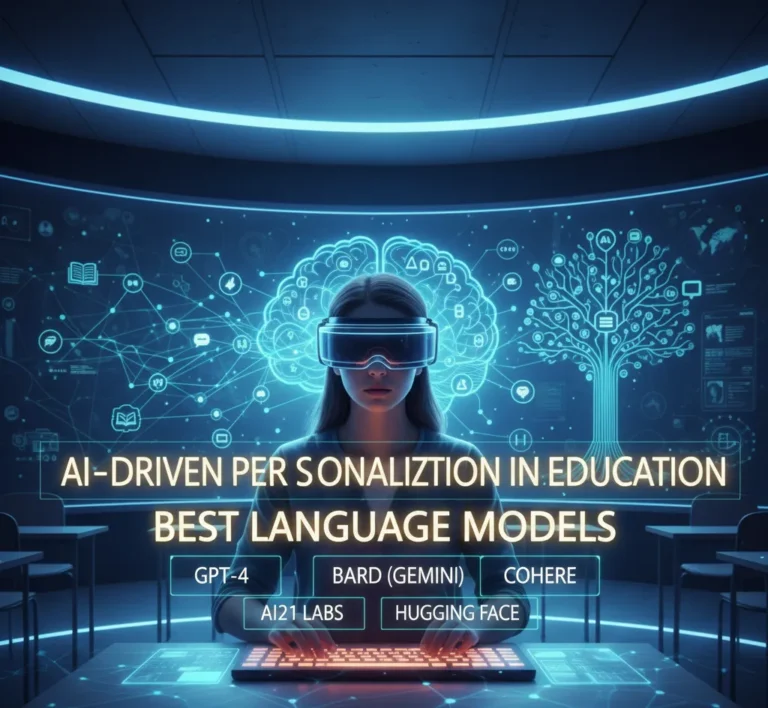
In today’s digital classrooms, AI-driven personalization & large language models in education are reshaping how students learn and how teachers teach. Schools and universities across the world are adopting AI technologies to create adaptive learning experiences — adjusting content, pacing, and feedback based on each student’s unique needs. With these intelligent systems, lessons can evolve in real time, offering personalized support for every learner.
Large language models (LLMs) — such as those behind chatbot tutors and smart feedback systems — are being integrated not just as tools for writing or student support, but for tutoring, content creation, language assistance and special-needs support. For example, a survey paper on LLMs in education underlines their ability to provide real-time, contextually relevant feedback, adapt to learning styles and generate customized materials.
Why it matters: When education becomes more attuned to where a student is — their knowledge gaps, their pace, their language ability — learning becomes not just more efficient, but also more engaging. Also teachers can spend less time on “one size fits all” content and more time on the human-centred parts of teaching: mentoring, supporting thinking, fostering collaboration and creativity. At the same time, adaptive systems can help bridge learning gaps by meeting students where they are rather than expecting all to move at the same speed.
2. Real-World Uses, Benefits and Emerging Challenges
Real-world uses & benefits
In practice, AI-powered personalization and LLMs are being used in these ways:
Adaptive content delivery: Systems monitor student responses, pace, mistakes, and then adjust the next content module accordingly (faster for strong topics, slower or more support for weaker areas). ResearchGate
Tutoring and writing/feedback support: LLMs can act as virtual tutors, helping students with language difficulties, drafting ideas, polishing writing, solving problems, or generating practice questions.
Automating repetitive or time-intensive tasks: Teachers can offload things like quiz creation, initial feedback, content repurposing, giving them more time for high-impact interactions. arXiv
Greater engagement & efficiency: Because content is tailored, students may feel more motivated (it feels “just right” for them), which can reduce wasted time and increase retention of learning.
Emerging challenges
Nevertheless, these advancements also present a number of important challenges:
Fairness and bias: AI systems are biased if their training data and system designs are biased. If we don’t pay attention to this, they can further entrench or create biases in decisions (for example, favouring students who had extra resources before). This was flagged among others in the survey on LLMs in education. arXiv
Privacy and access: While customised learning systems often need to collect data about how students learn, their mistakes, their pace, etc., data privacy and ethical use will be paramount. Moreover, if technology ultimately is not equally accessible, we are likely to perpetuate or exacerbate the digital divide.
Academic integrity: If LLMs can generate writing, make homework answers or provide assistance to a high degree, what impact will that have on cheating, plagiarism or simply relying on the AI too heavily for your own learning?
Quality and human-centred teaching: While AI can automate a lot of function and tasks, human teachers can’t be fully re-placed in the roles of mentorship, empathy, critical thinking, values and content expertise. Moreover, getting the AI to produce accurate, current and sound pedagogically content is no small task. The survey paper suggests that limited yields, transparency and technological readiness are genuine barriers. arXiv.
3. Towards a Thoughtful Implementation: What Schools and Universities Should Consider
To make the transition meaningful, institutions should focus on the following three core dimensions:
A. Start with the learner
When implementing adaptive-AI systems, begin by understanding your students: their backgrounds, learning styles, support needs, language challenges, and access to devices/internet. Personalisation only works when the system and teacher design are aligned to those realities.
B. Blend AI with human insight
Large language models and AI-based personalization in education are tools, not a replacement. Use tools to free up teacher time from repetitive tasks (like quiz creation, basic feedback), so the human teacher can focus on what humans do best and be interactive, mentoring students, critical thinking, student growth, and socio-emotional support.
C. Address ethics, access and integrity from day one
Develop transparent policies regarding data utilization, student privacy, algorithmic fairness, and the monitoring and review of the used AI systems.
Ensure equitable access is present so students from underserved backgrounds can utilize the tools instead of being excluded.
Integrate academic integrity safeguards so there are defendable guidelines to establish what is considered permissible, how to responsibly use AI tools in education, and how AI tools can be integrated into assessment design.
Evaluate the outcomes of your efforts by measuring not only student engagement but also learning outcomes, whether the personalized content of the AI tools is leading to meaningful learning results, and if any students are still not being engaged educationally.
By thoughtfully embracing AI-driven personalization & large language models in education, educators and institutions can open the door to more engaging, efficient and inclusive learning experiences. But the promise will only be fulfilled if implementation is grounded in human values, informed by ethics, and accessible to all.
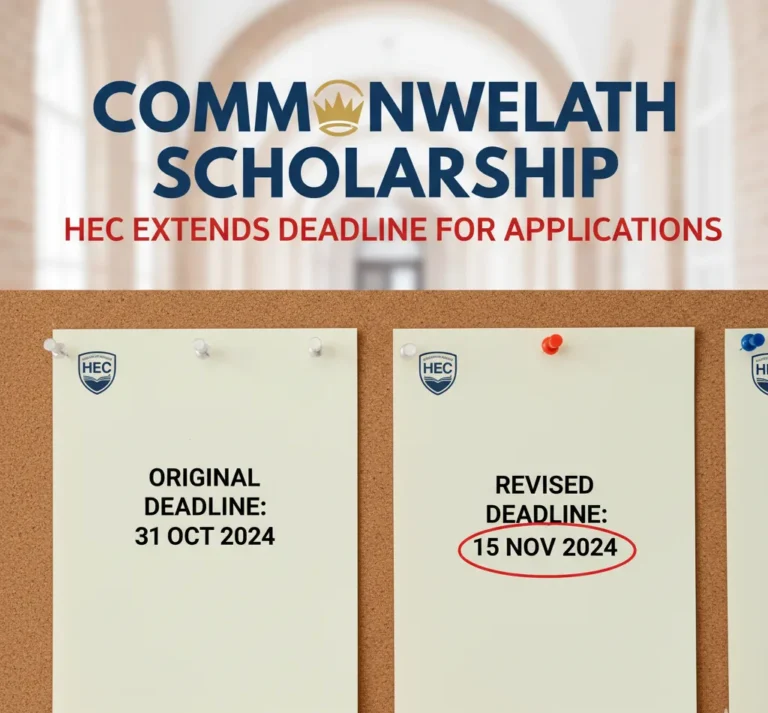
The Commonwealth Scholarship 2025–26 Pakistan program deadline has been officially extended by the Higher Education Commission (HEC), offering a valuable second chance to students from Pakistan and Azad Jammu & Kashmir who aspire to study in the United Kingdom. Funded by the British Government and administered by the Commonwealth Scholarship Commission (CSC) in collaboration with HEC, this prestigious scholarship covers Master’s and PhD studies for exceptional Pakistani scholars. This year, 56 fully funded scholarships are available — 26 for Master’s and 30 for PhD candidates — opening doors to world-class education and international research opportunities.
What the Scholarship Offers & Who Can Apply
This scholarship program is funded by the UK government and administered jointly by HEC and the Commonwealth Scholarship Commission. The benefits are generous: full tuition fees, airfare, living allowances, research travel grants, and more for selected students.
To be eligible, applicants must be Pakistani or AJK nationals, hold first division degrees (16 years education for Master’s, 17/18 years for PhD) and no second/third division in their terminal degree. Higher Education Commission+2Careers Help Desk+2 Dual nationals are not permitted, and the candidates may also need to demonstrate English proficiency.
HEC encourages female participation and ensures a minimum 45% female nomination ratio.
Tips to Maximize Your Chance & What’s New in the Extension
(a) Prepare Strong Documents
First of all your application should include transcripts, a research proposal (for PhD), letters of recommendation, and proof of English proficiency (IELTS/TOEFL or equivalent). Students awaiting final exam results may apply conditionally.
(b) Use the Extended Time Wisely
And also with the extension in place, refine your study plan, polish your motivation letter, and secure strong referees. Double-check that you submit both your HEC and Commonwealth portal applications before the new deadline.
(c) Stay Updated & Follow HEC updates
for keep in touch yourself always refer to the HEC official website for the final, authoritative application dates and details. Avoid third-party misinformation.
Why the Extension Matters
Many eligible students may have missed earlier cutoffs; this extension provides a second chance. It also reflects HEC’s commitment to reaching more talented applicants across Pakistan and AJK.
Conclusion
The Commonwealth Scholarship 2025–26 Pakistan program is a golden opportunity for Pakistani and AJK students to pursue advanced degrees in the UK, fully funded. With HEC’s recent deadline extension, more students can now prepare and submit high-quality applications. If you meet the eligibility and are passionate about impactful research or studies abroad, don’t let this second chance slip by—start your application process now.
The New HEC Rule and the Rise of English Linguistics Confusion
In 2025, the Higher Education Commission (HEC) of Pakistan imposed new frameworks on postgraduate degrees in English Studies, specifying only two degrees English Literature and English Linguistics that universities are permitted to offer. While this may superficially appear to promote consistence, English Linguistics confusion is actually an unintended consequence of the policy. The policy creates confusion by consolidating and collapsing the disciplinary distinctions in the study of Applied Linguistics, TESOL, and English Language Teaching through a single label; all the attention for these areas is under the responsibility of English Linguistics. This is a dramatic change from the HEC national curriculum framework from 2017 which accounted and credit the disciplinary distinctions of Applied Linguistics and TESOL with distinct degree pathways creating a definitive English degree confusion and measurable course of studies and qualifications between postgraduate research and career pathways for students. The 2017 framework reflected a global model for postgraduate research study and was more transparent for the student and employers Linguistics vs Literature (beyond just the obvious implications of the qualification). Without the categorical distinctions of disciplines with the new framework, both, universities and their students are left interprelation the overlapping academic boundaries and meanings.
This issue has significance because, by definition, English Linguistics confers a limitation on inquiry to the English language alone. Linguistics, more generally, is a broader scientific enterprise in the study of human language, ranging from phonetics to language policy. Specifically, Applied Linguistics relates to teacher education, curriculum design, and multilingual education—all of which are key areas in the context of Pakistan’s language diversity. The new document relegates these areas into a more narrow category of English Linguistics and raises the question of definition of the field and the new policy’s capacity for addressing local and global needs.
Why This Change Risks Pakistan’s Academic Reputation
HEC English Studies 2025 belive that the uncertainty of English Linguistics extends beyond academia and meaning; it affects possible employment and recognition worldwide. Applied Linguistics in Pakistan or TESOL qualifications are sought after across universities and employers in countries like the UAE, China, Singapore, or parts of Europe. An English Linguistics degree may require further explanation or simply not qualify for various employment opportunities. In essence, Pakistani graduates may encounter challenges applying for international teaching jobs or doctoral programmes. The challenge is not that Pakistan is lacking talent or expertise; the challenge is that the name of the degree is not relevant to what the world is employing qualified applicants.
Even within Pakistan, the new framework complicates curriculum design. Courses like Advanced Research Methods in English Studies may serve literature students but not linguistics researchers who require tools like corpus analysis, phonetics, or data-driven methodologies. By merging these disciplines under one umbrella, HEC’s standardisation unintentionally weakens academic precision. Faculty trained in applied linguistics or TESOL find themselves boxed into a label that doesn’t reflect their expertise, while literature scholars are forced into frameworks that don’t fit their methods. Universities like Punjab, Karachi, and Peshawar still lean toward literature, but the demand for linguistics and applied linguistics is growing — both globally and locally. Private universities such as UCP, UMT, Riphah, Air University, and BNU have made significant strides by offering full-fledged programmes in these areas. The new HEC rule risks undermining that progress, making Pakistani degrees less visible on the international stage.
Towards Clarity, Recognition, and Global Alignment
The confusion surrounding English Linguistics should be seen not only as a policy flaw but as an opportunity to rethink how Pakistan defines and structures its English Studies. True academic growth comes from clarity, not conformity. Restoring separate degree titles for Linguistics, Applied Linguistics, and TESOL would help align Pakistan with global practices, where each field has its own identity, methods, and research scope. Internationally, institutions like Cambridge, Oxford, Harvard, and the University of Melbourne maintain distinct departments for Linguistics and Applied Linguistics — and even within South Asia, universities in India and Bangladesh follow this model. Pakistan’s universities should be empowered to do the same rather than being confined by an outdated umbrella of “English Studies.”
To improve Pakistan’s higher education sector, the policy makers need to appreciate that English Linguistics cannot stand for the entire breadth of linguistic scholarship. Students deserve degrees that accurately represent their education. Faculty deserve not to be mistaken for someone who just teaches English as a second language. Employers deserve to understand what expertise they are hiring when they recruit a graduate. The rest of the world has already differentiated both literature and education studies from linguistics; it is time for Pakistan to do so as well. The solution does not require the abandonment of a standard, but instead calls for reframing the way it has been administered to allow for reasonable addition, while maintaining clarity, international standards, and scholarship. Until that happens the muddle of English Linguistics will continue to cover up the real potential of Pakistan’s linguistics community, and limit the recognition our scholars earn the right to.